
Este artículo aún no está traducido — estás leyendo el original en inglés.
Why Manga Translation Is One of the Hardest Problems in Multimodal AI
Explore why manga translation is a uniquely difficult multimodal AI challenge involving OCR, computer vision, reading order, image inpainting, and localization
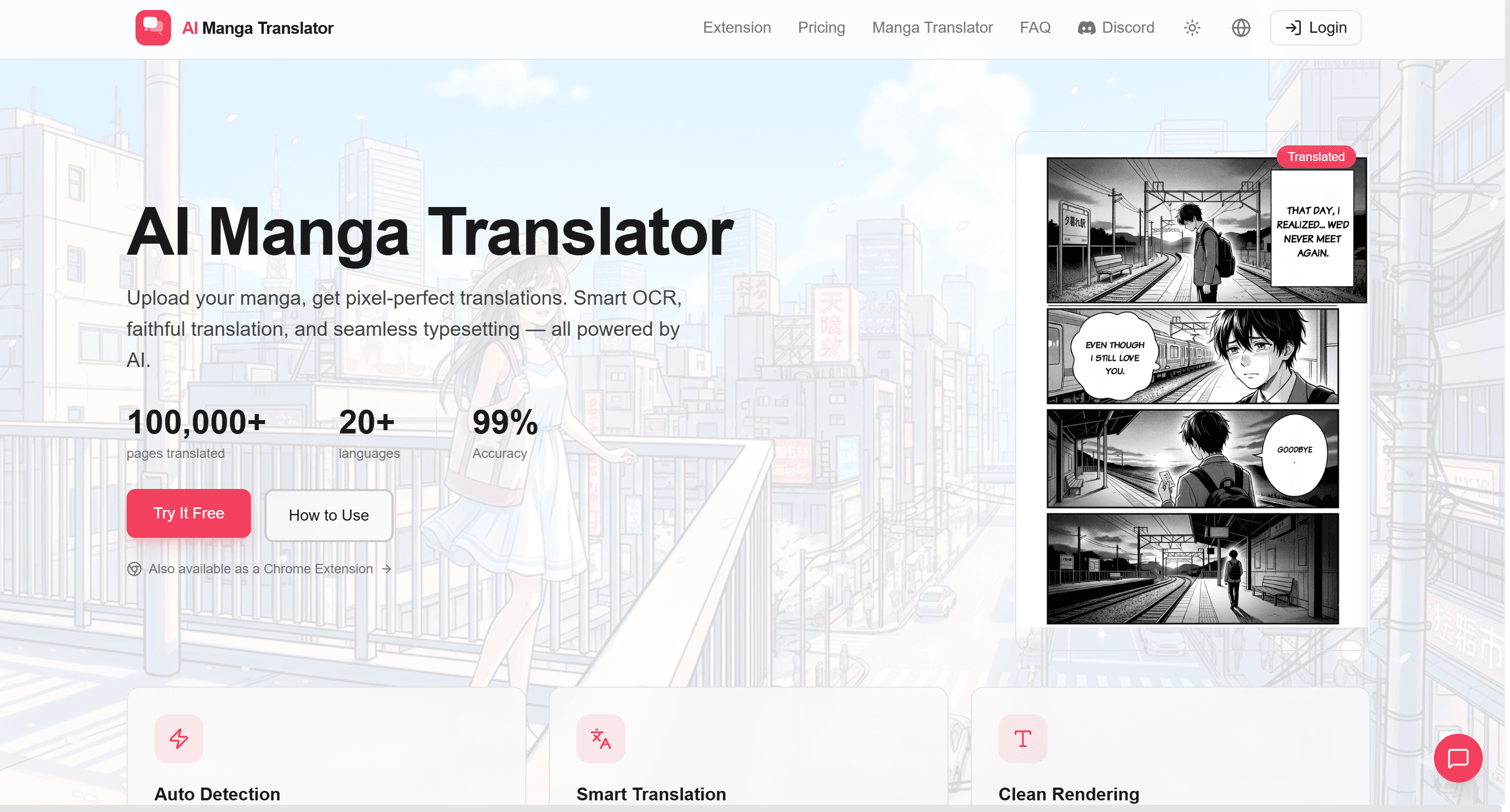
Artificial intelligence has become remarkably good at translating text. Large language models can summarize documents, answer questions in multiple languages, and translate conversations with impressive accuracy.
But manga is different.
Unlike plain text, manga combines artwork, dialogue, typography, reading order, and cultural context into a single visual medium. Translating it requires far more than converting Japanese into English, it requires understanding how images and language work together.
This is why manga translation has become one of the most interesting challenges in multimodal AI.
Text Is Embedded Inside Artwork
Traditional translation systems assume that text exists separately from images.
Manga does the opposite.
Dialogue is drawn directly inside speech bubbles. Sound effects are integrated into illustrations. Captions often overlap with artwork, and text may appear vertically, horizontally, or at unusual angles.
Before translation can even begin, an AI system must identify which pixels belong to text without damaging the surrounding artwork.
Unlike scanned documents, there is rarely a clean separation between text and background.
OCR Alone Isn't Enough
Optical Character Recognition (OCR) is often considered the first step of translation.
For manga, it is only the beginning.
A successful system must recognize:
Vertical Japanese text
Handwritten fonts
Stylized typography
Rotated dialogue
Sound effects integrated into artwork
Low-resolution or compressed scans
Even after text is recognized, another challenge appears: preserving the original artwork.
Simply covering text with a white rectangle produces unnatural results. Modern systems instead use AI inpainting to reconstruct the missing background before placing translated text.
This combination of OCR and image restoration is one reason manga localization is significantly more difficult than document translation.
Layout Is a Computer Vision Problem
One of the biggest differences between manga and ordinary text is layout.
Every page contains multiple visual elements that interact with one another:
Speech bubbles
Panels
Captions
Sound effects
Characters
Background illustrations
These elements frequently overlap, intersect, or break traditional reading patterns.
Because of this, translation systems cannot process text independently. They must first understand the structure of the page itself.
This is fundamentally a computer vision problem rather than a language problem.
The Hidden Challenge: Understanding Manga Reading Order
Humans instantly understand how to read a manga page.
We naturally follow the correct sequence from one panel to the next and from one speech bubble to another.
AI does not.
A model typically detects multiple text regions without knowing which should be read first.
To translate a page correctly, an AI system must infer:
Panel hierarchy
Speech bubble sequence
Right-to-left reading order
Relationships between dialogue and visual context
Without this structural understanding, even perfect translation quality can produce confusing or incorrect results.
If you're interested in this topic, we explored it in more detail in How AI Understands Manga Reading Order.
Translation Is Only One Part of Manga Localization
Many people assume that once an AI generates an accurate translation, the job is finished.
In reality, translation is only one stage of a much larger pipeline.
A complete manga localization workflow typically includes:
OCR
Translation
Image inpainting
Typesetting
Each stage depends on the previous one.
Poor OCR reduces translation quality.
Poor background restoration leaves visible artifacts.
Poor typesetting makes pages difficult to read, even if the translation itself is accurate.
This is why manga localization is better understood as an end-to-end multimodal AI problem rather than a standalone language task.
For a technical overview of the entire pipeline, see How Manga Translation Actually Works.
Why AI Manga Translation Is Becoming Possible Now
Only a few years ago, building an automated manga translation system was largely impractical.
Several technological advances have changed that.
Recent progress includes:
More capable computer vision models
Stronger OCR systems
Multimodal large language models
Generative image restoration techniques
Better document and layout understanding
Modern AI systems can increasingly reason across both visual and textual information instead of treating them as separate inputs.
As a result, manga translation has emerged as an active research area within multimodal AI, combining computer vision, natural language processing, and generative modeling into a single workflow.
The Future: AI-Assisted Manga Localization
AI is unlikely to replace professional translators.
Instead, it changes where human expertise is most valuable.
As translation technology improves, we can expect:
Independent creators to publish comics for global audiences more easily
Publishers to localize content faster across multiple languages
Professional translators to spend more time on cultural adaptation, tone, and editorial quality rather than repetitive production work
The future of manga localization is likely to be collaborative, with AI handling repetitive technical tasks while humans focus on creativity and cultural nuance.
Conclusion
Manga translation demonstrates why multimodal AI is fundamentally different from text generation alone.
A successful system must understand language, images, layout, reading order, and visual reconstruction simultaneously. Solving these problems requires combining advances from computer vision, OCR, multimodal reasoning, and generative AI into a unified workflow.
At PetersLab, we explore how AI transforms creative workflows across translation, image understanding, and content generation. Our work on AI Manga Translator is one example of how modern computer vision and generative AI can solve localization challenges that previously required significant manual effort.
If you'd like to learn more, visit https://ai-manga-translator.com and https://ai-manga-translator.com/extension